Juto Bio
Next-generation Microalgae-Based Biostimulants, From Waste
Using waste to improve plant health
Our Vision
The world must grow more food on less land, with fewer inputs. Soils are depleting, crops are increasingly vulnerable, and agriculture remains a leading driver of global emissions.
At the same time, Scotland's whisky industry generates 2.7 billion litres of pot ale waste every year, a nutrient-rich by-product with nowhere useful to go. We believe the answer to both problems is the same: microalgae.
Our Mission
To bring to market the world's first whisky waste-derived microalgae biostimulant, delivering measurable improvements in crop yield, stress resilience, and soil health, while redirecting one of Scotland's most persistent waste streams towards agricultural innovation.
We are building a future where sustainable farming is not a compromise, but a competitive advantage.
How It Works
Whisky Waste
Scotland's whisky distilleries produce an enormous volume of pot ale, the liquid by-product left after distillation. Rich in sugars, nitrogen, and minerals, this waste is costly to dispose of and damaging to waterways.
Algae Growth
Our proprietary microalgae strain thrives on pot ale as a growth medium, converting its sugars and nutrients into biomass. This process converts a problematic waste effluent directly into a high-value biostimulant.
Biostimulants
The harvested algae biomass is processed into a biostimulant formulation applied directly to crops, delivering measurable improvements in plant vigour, yield, and resistance to environmental stress.
Reducing waste, improving outputs
2.7B litres
Reducing Whisky Industry Waste
Scotland's distilleries generate 2.7 billion litres of pot ale waste annually. JutoBio converts this nutrient-rich by-product into a valuable agricultural input, diverting it from waterways and landfill.
Up to +20%
Improved Crop Yield
Our microalgae biostimulant promotes root development, nutrient uptake, and photosynthetic efficiency, delivering measurable increases in harvestable yield across a range of arable and horticultural crops.
Up to −20%
Reduced Fertiliser Usage
By enhancing the plant's natural ability to absorb and utilise soil nutrients, JutoBio biostimulants reduce dependence on synthetic nitrogen and phosphorus inputs, lowering cost and runoff pollution.
Up to −15%
Reduced Pesticide Usage
Healthier, more vigorous plants are naturally more resistant to pests and fungal disease. Treated crops show improved systemic resistance, reducing the need for chemical pesticide applications.
Stress resilient
Climate Change Resilience
Algae-derived biostimulants have been shown to prime crops for abiotic stress, including drought, heat, and salinity, helping farmers maintain yields as growing conditions become increasingly unpredictable.
Lower emissions
Reduced Carbon Footprint
JutoBio cuts emissions on two fronts: diverting pot ale waste reduces the environmental burden on Scotland's distilleries, while helping farmers achieve higher yields with fewer synthetic inputs lowers the carbon cost of food production.
The people behind JutoBio

Jude Taylor
Co-Founder
Jude drives JutoBio's commercial strategy and operations, translating cutting-edge algae science into scalable agricultural solutions. A Biotechnology graduate of the University of Edinburgh and Imperial College London, he is focused on building partnerships across the agri-food and whisky industries.

Thomas England
Co-Founder
Thomas leads JutoBio's scientific development, overseeing strain selection, cultivation processes, and biostimulant formulation. With a background in Biotechnology from the University of Edinburgh and Imperial College London, he brings a rigorous, research-driven approach to every stage of the pipeline.
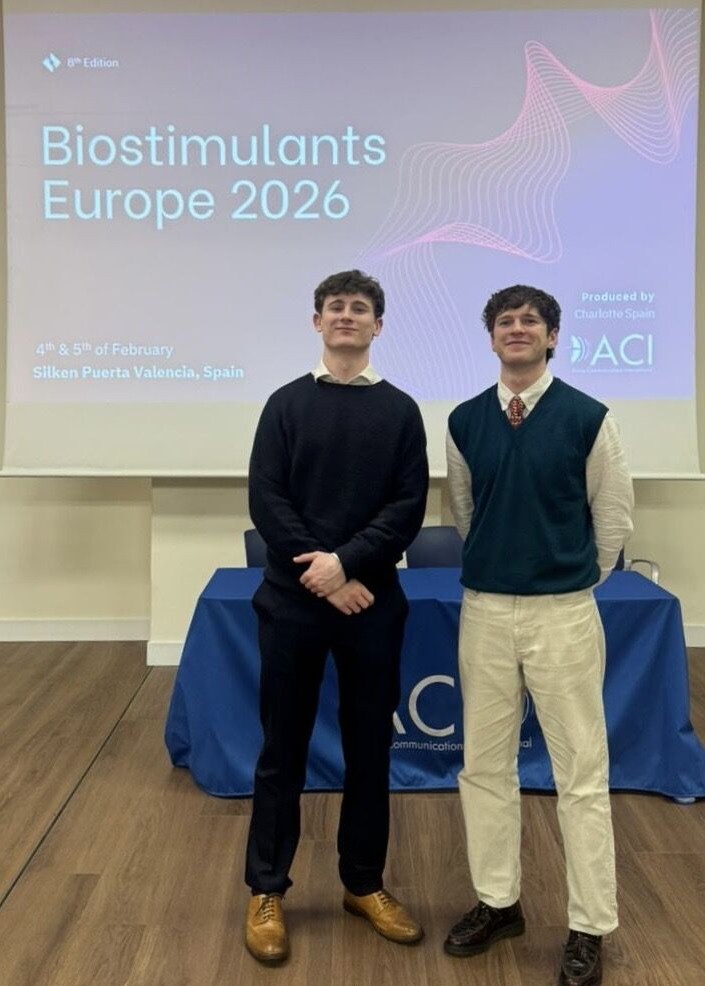
Jude and Thomas met studying Biotechnology at the University of Edinburgh, where a shared fascination with microbial systems and sustainable agriculture first took root. Both now study at Imperial College London, where Jude studies Bioscience Futures and Thomas studies Applied Biosciences and Biotechnology.
Thomas brings a direct understanding of farming that goes beyond the laboratory. Growing up with an agricultural background, he has seen first-hand the mounting pressure that rising input costs place on farmers, and the environmental toll that intensive farming practices exact on the land.
Jude, born and raised in Glasgow, grew up immersed in Scotland's whisky culture. That proximity made one thing clear: the industry's vast volumes of pot ale waste represented not just an environmental problem, but an untapped opportunity.
They founded JutoBio in September 2025 and have spent the past six months developing and refining their biostimulant formulation. Their goal is straightforward: to improve global food security through sustainable, biology-led means.
Follow JutoBio on LinkedIn